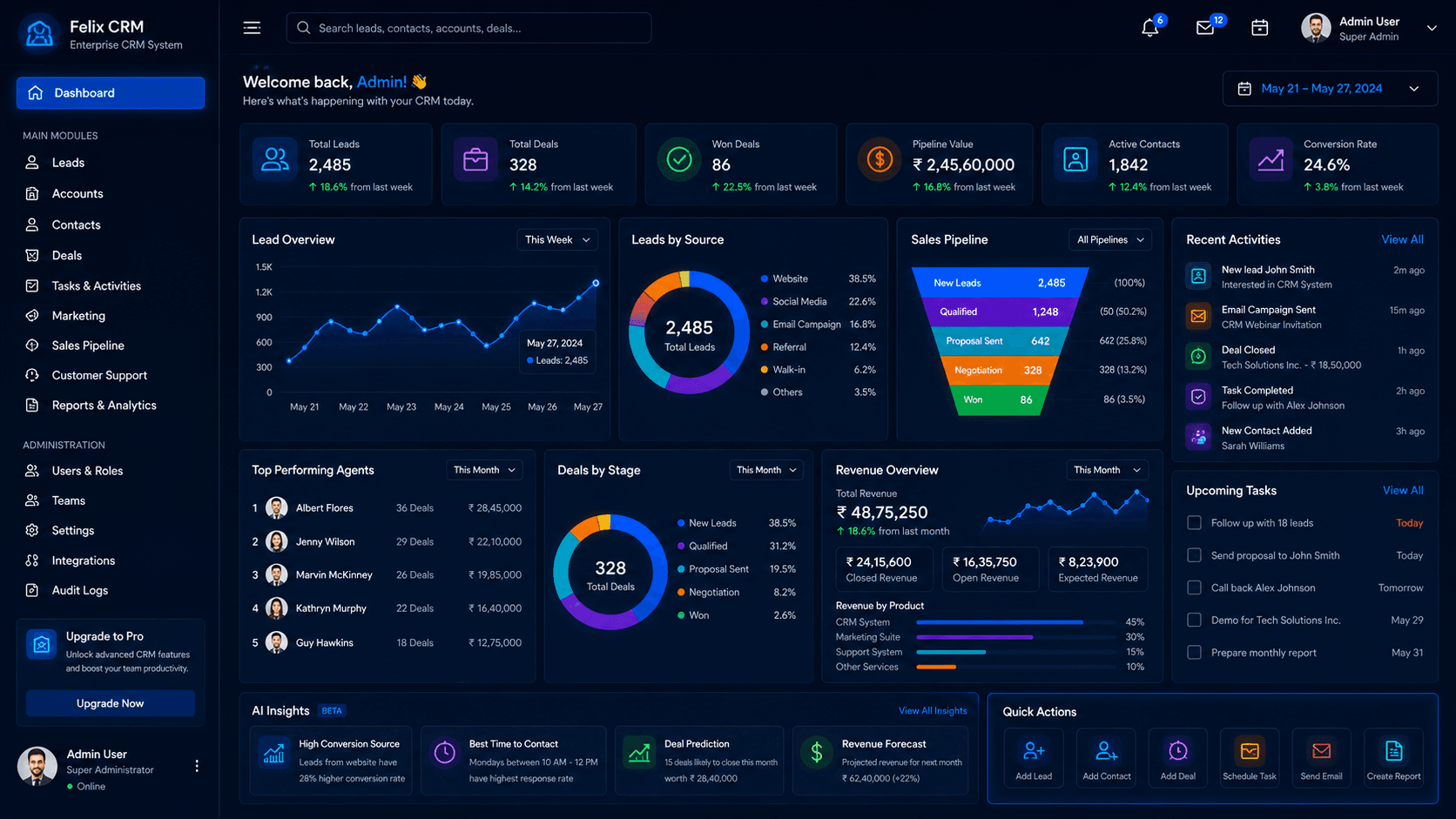
We developed a comprehensive Enterprise CRM System designed to centralize customer management, sales operations, lead tracking, and business communications within a single digital platform.
The solution provides organizations with better visibility into their sales pipeline, customer interactions, team performance, and revenue forecasting while improving operational efficiency across departments.
The Enterprise CRM System enables businesses to manage customer relationships more effectively and make data-driven decisions through real-time analytics, structured workflows, and automation.
By bringing customer information, sales activities, follow-ups, and reporting into a centralized environment, the platform helps teams maintain a more organized approach to the complete customer lifecycle.
The client was managing customer data across multiple spreadsheets, emails, and disconnected software systems. This made it difficult for teams to maintain a consistent view of customer interactions and sales activities.
This created several operational challenges:
As the business expanded, these issues began impacting productivity, customer experience, sales coordination, and overall business growth. The client required a centralized solution that could organize customer information while providing sales teams and management with actionable business visibility.
Felix Technologies designed and implemented a custom Enterprise CRM System tailored to the client’s business processes and customer management requirements.
The solution brought customer information, lead management, sales activities, communication history, reporting, and team performance information together within a structured digital environment.
Key features included:
The platform streamlined the complete customer lifecycle from lead acquisition to deal closure while helping teams access relevant customer and sales information more efficiently.
The approach follows the core purpose of CRM technology: bringing customer relationships, interactions, lead management, and sales information into a more connected and manageable environment. IBM’s CRM overview also explains how CRM systems can support customer relationships, lead management, sales forecasting, and communication workflows.
The Enterprise CRM System was structured around the operational requirements of sales and customer management teams. Its centralized architecture helps organizations organize customer information and maintain greater visibility across business activities.
These capabilities provide businesses with a more structured approach to managing customer relationships, sales operations, follow-ups, and performance reporting.
The Enterprise CRM System implementation generated significant business improvements across sales operations, reporting, customer management, and team productivity.
The implementation helped create a more organized sales environment by reducing dependence on disconnected information sources and improving access to relevant customer and pipeline data.
The centralized Enterprise CRM System improved the way the organization managed customer information, sales activities, follow-ups, and performance reporting.
With customer and sales information available through a structured platform, teams could spend less time searching across spreadsheets and disconnected systems and more time managing customer relationships and sales opportunities.
Automated follow-up workflows also helped create a more consistent process for handling leads and customer communication. Management teams gained improved visibility into sales activity, team performance, and forecasting information.
The resulting digital environment provided a stronger foundation for improving operational efficiency, customer engagement, sales coordination, and long-term business growth.
An Enterprise CRM System provides businesses with a practical way to centralize customer information, organize sales pipelines, manage follow-ups, and improve visibility across customer-facing operations.
For organizations managing growing numbers of customers, leads, sales opportunities, and communication activities, a centralized CRM environment can provide a more consistent approach than relying on spreadsheets, emails, and disconnected applications.
Felix Technologies develops customized digital platforms around specific business requirements, allowing CRM workflows to be structured around the organization’s operational processes, reporting needs, user roles, and growth objectives.
Businesses can also explore our Ecommerce Platform project to see how Felix Technologies approaches centralized digital business solutions across different operational environments.
The Enterprise CRM System transformed the client’s sales and customer management operations by providing a centralized, intelligent, and scalable digital platform.
With automation, analytics, structured customer data, and real-time insights, the solution enabled the organization to improve customer relationships, increase operational efficiency, and accelerate revenue growth.
The project demonstrates how a customized CRM solution can bring customer management, sales operations, reporting, and business workflows together within a unified digital environment.
For businesses looking to improve customer management and sales operations through a customized digital platform, Felix Technologies can develop solutions aligned with specific business requirements and operational workflows.
Team Productivity
Process Automation
Customer Records
Have a project in mind? Felix Technologies helps businesses build scalable software, AI automation, websites and digital solutions designed for growth.